Talks & Lectures
New Guard, No Guard | The Zero-Multiplier Paradox | Win and Remain Human | Winning the Learning Competition
Strategic talks for organizations, defense forums, universities, executive programs, and government institutions.
← → Arrow keys to navigate between talks
Swipe left / right to navigate between talks
 TALK 01 / 04
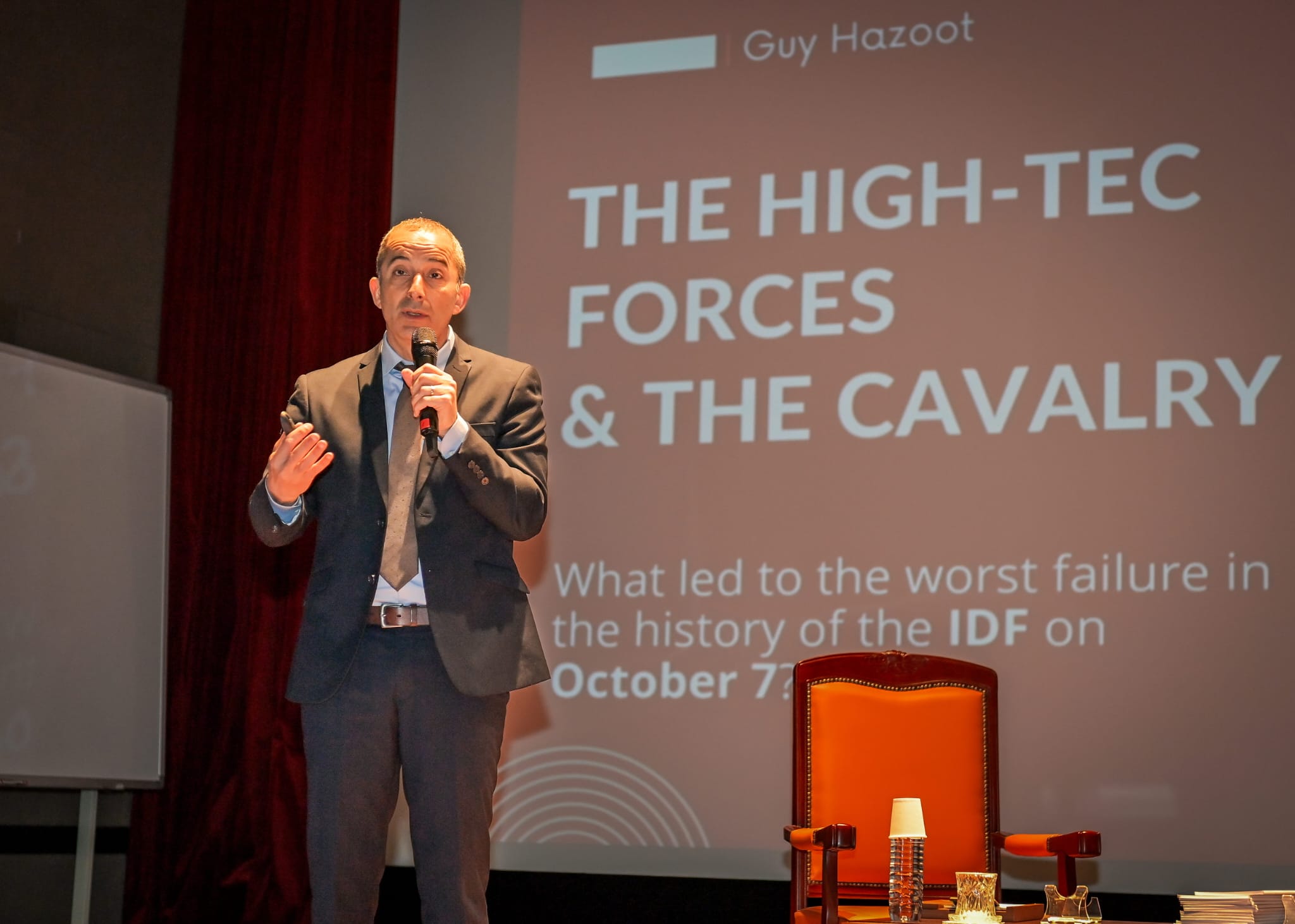
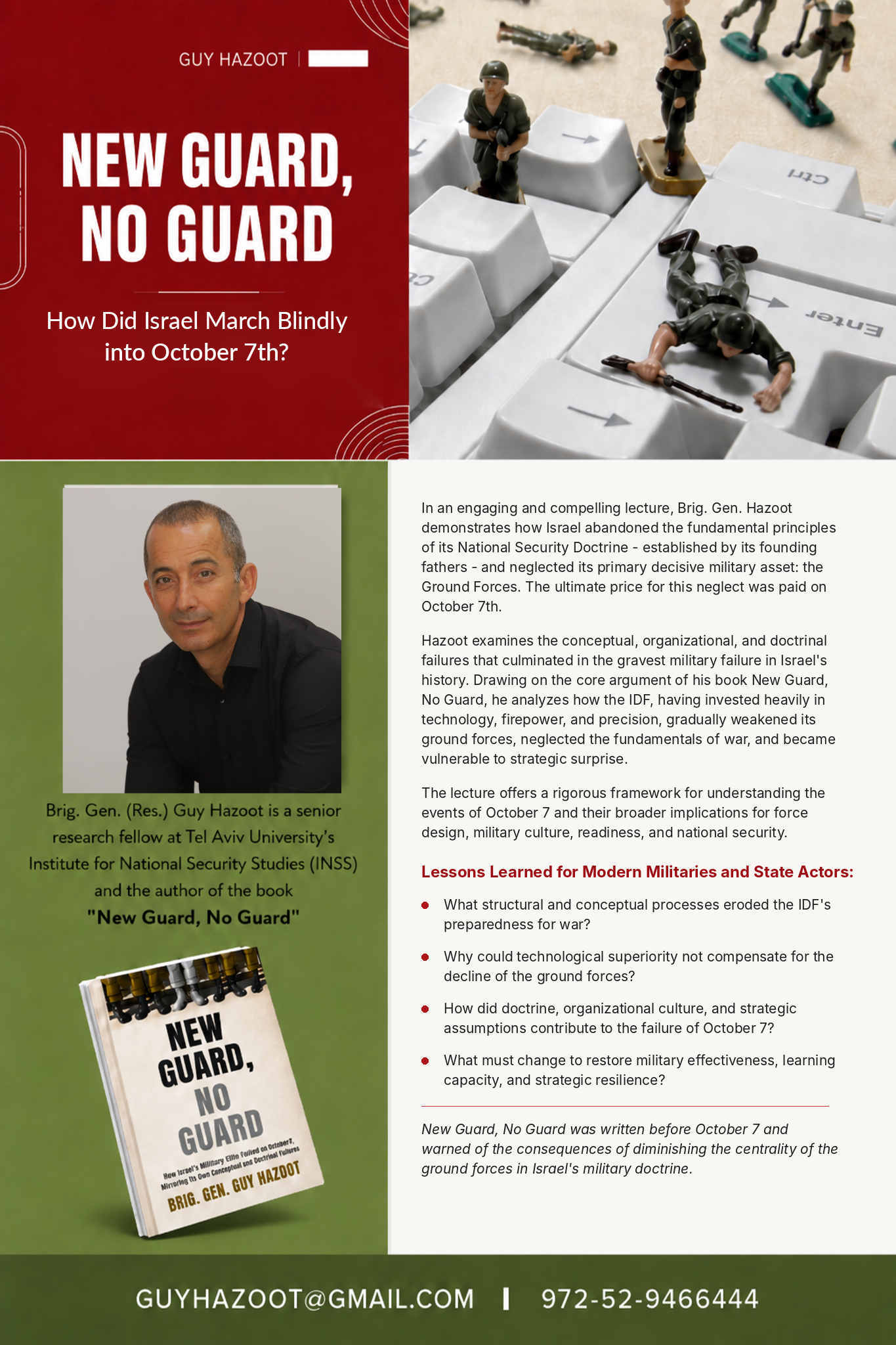
New Guard, No Guard
What led to the worst failure in the history of the IDF on October 7?Brig. Gen. (Res.) Guy Hazoot examines the conceptual, organizational, and doctrinal failures that culminated in the gravest military disaster in Israel's history. Drawing on the core argument of his book New Guard, No Guard, he analyzes how the IDF, having invested heavily in technology, firepower, and precision, gradually weakened its ground forces, neglected the fundamentals of war, and became vulnerable to strategic surprise. The lecture offers a rigorous framework for understanding October 7 and its broader implications for force design, military culture, readiness, and national security.
- What structural and conceptual processes eroded the IDF's preparedness for war?
- Why could technological superiority not compensate for the decline of the ground forces?
- How did doctrine, organizational culture, and strategic assumptions contribute to the failure of October 7?
- What must change for Israel to restore military effectiveness, learning capacity, and strategic resilience?
 TALK 02 / 04
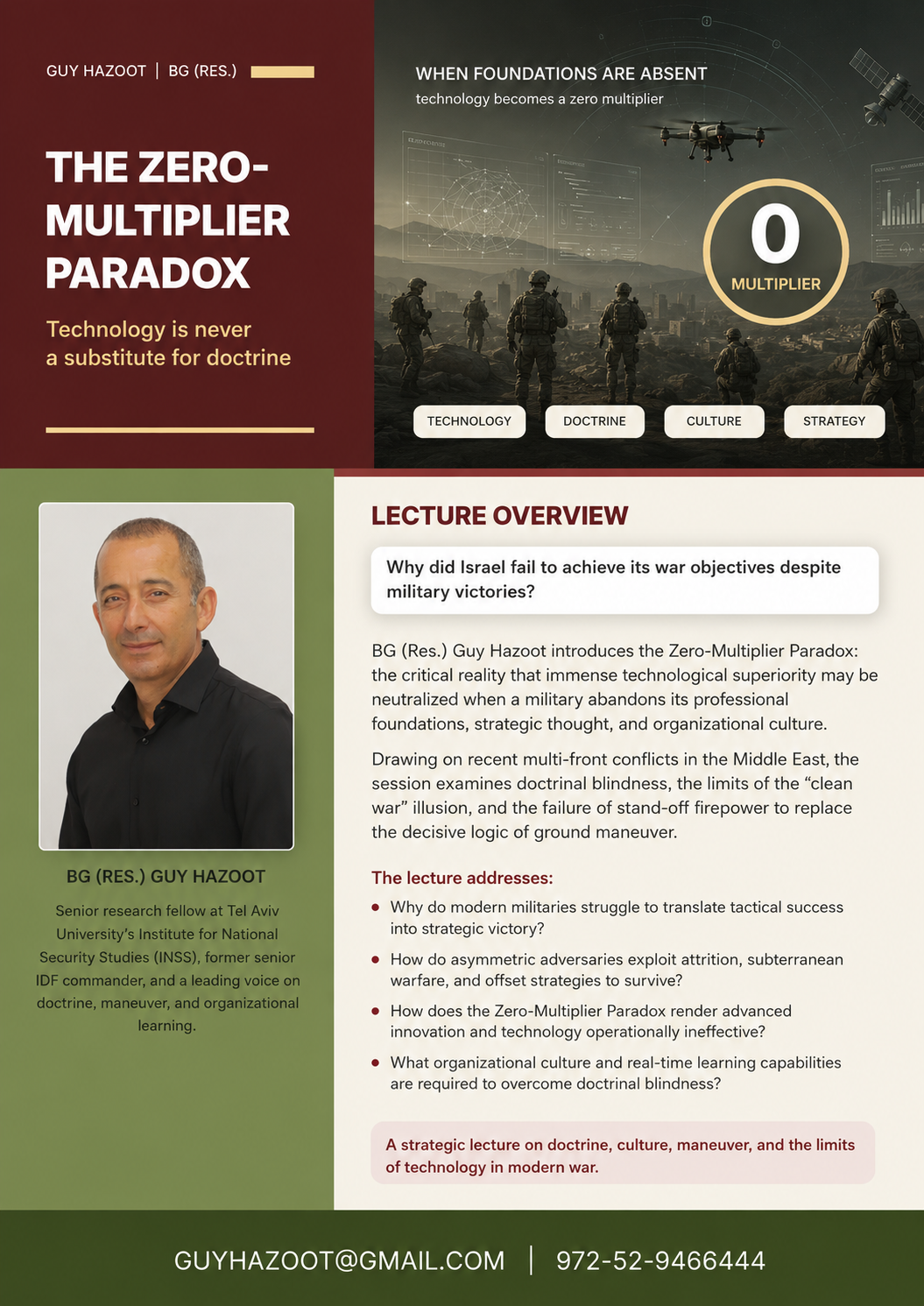
The Zero-Multiplier Paradox
Technology is never a substitute for doctrineBG (Res.) Guy Hazoot introduces the Zero-Multiplier Paradox: the critical reality that immense technological superiority may be neutralized when a military abandons its professional foundations, strategic thought, and organizational culture. Drawing on recent multi-front conflicts in the Middle East, the lecture examines doctrinal blindness, the limits of the "clean war" illusion, and the failure of stand-off firepower to replace the decisive logic of ground maneuver.
- Why do modern militaries struggle to translate tactical success into strategic victory?
- How do asymmetric adversaries exploit attrition, subterranean warfare, and offset strategies to survive?
- How does the Zero-Multiplier Paradox render advanced innovation and technology operationally ineffective?
- What organizational culture and real-time learning capabilities are required to overcome doctrinal blindness?
 TALK 03 / 04
Win and Remain Human
On the fine line between victory and losing your values on the battlefieldThrough the Azaria affair-the 2016 shooting of a neutralized Palestinian attacker in Hebron by an IDF soldier, one of the most contentious events in recent Israeli military history-Hazoot delivers a gripping, first-hand account of how that episode reshaped IDF-society relations and the military's own combat ethics. He commanded the Hebron sector at the time and speaks from direct experience, not commentary from the sidelines.
- Morality and victory-are they in conflict? And what happens when it seems they are
- The red line that must not be crossed-and what it costs when it is
- Moral leadership in a public crisis: lessons from the Azaria affair
- How to preserve a human face inside the machinery of war
 TALK 04 / 04
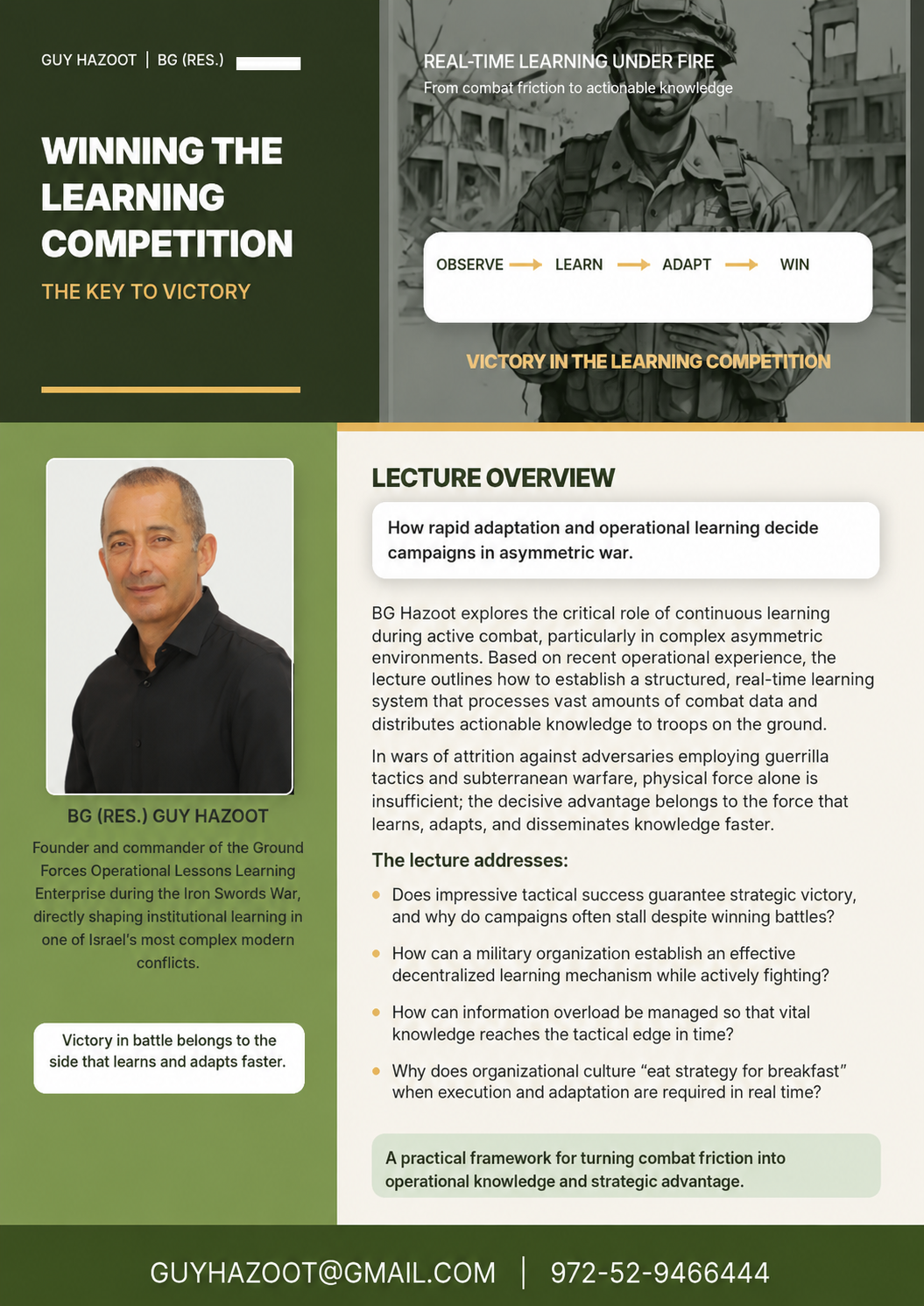
Winning the Learning Competition
The key to victory-real-time learning under fireBG Hazoot explores the critical role of continuous learning during active combat, particularly in complex asymmetric environments. As founder and commander of the IDF Ground Forces' Operational Learning Directorate during the Iron Swords War, he outlines how to establish a structured, real-time learning system that processes vast amounts of combat data and distributes actionable knowledge to troops on the ground. The decisive advantage belongs to the force that learns, adapts, and disseminates knowledge faster.
- Does impressive tactical success guarantee strategic victory, and why do campaigns often stall despite winning battles?
- How can a military organization establish an effective decentralized learning mechanism while actively fighting?
- How can information overload be managed so that vital knowledge reaches the tactical edge in time?
- Why does organizational culture "eat strategy for breakfast" when execution and adaptation are required in real time?
New Guard, No Guard | The Zero-Multiplier Paradox | Winning the Learning Competition
Strategic talks for organizations, defense forums, universities, executive programs, and government institutions.